

Aylward Edward Dingle (poor fellow), usually credited as “Captain Dingle”, sometimes as “Captain A. E. Dingle”, was an enormously popular and successful author in the pulps in the 1920s, at least partly for the verisimilitude he brought to his stories. Dingle spent some twenty-two years at sea, and reportedly was shipwrecked five(!) times, so it is no surprise that most of his stories had a shipboard setting. And more than short stories, he published several full-length novels in the pulps, in Adventure, of course, but also Everybody’s, Argosy, Blue Book, Popular, and Munsey’s.
Two of his novels are on Gutenberg, and I’ve got at least two or three more at some stage of processing in order to publish, but that’s a way off, yet. I’ve sometimes pondered what impact he might have had if science fiction had piqued his interest in his middle age (he turned fifty-five in 1929), and he decided to apply his sailing knowledge to stories of the spaceways before anybody else. It would have been a serious pay cut, on top of everything else he would have had to contend with, but still, think of the tales we might have had...
Today’s story first appeared in Adventure, and it’s a slight departure from his usual type of story. Or, at least, I don’t know of another story of his where the central characters are a cop and the member of a drug gang he’s been chasing.
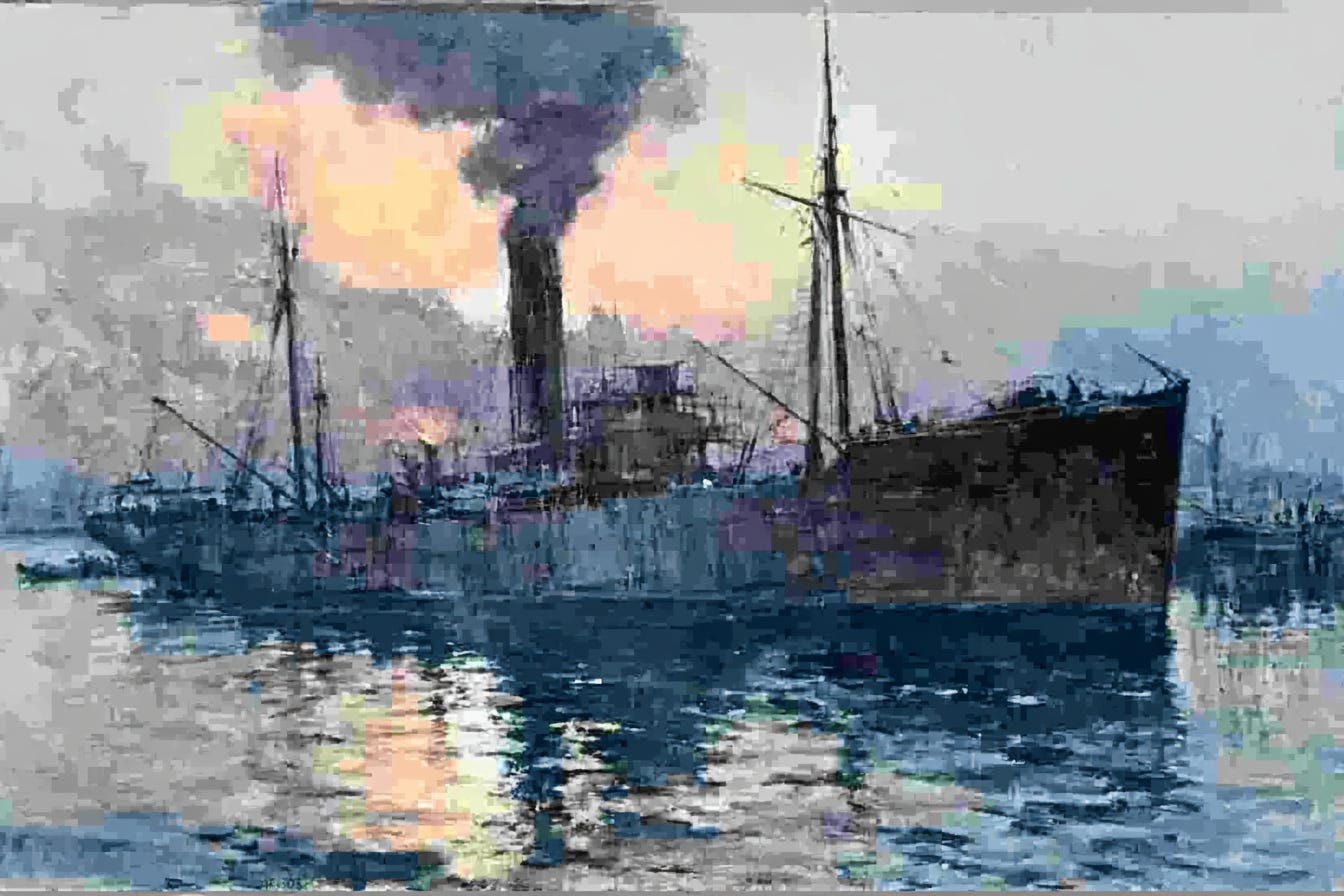
Bound South
by Captain Dingle
It was raining, which was bad enough. A cold rain, too. There was a clammy fog on the river, and the streets near the wharves were cheerless and dank, like a Russian hell where all is cold. Rats venturing from the ships to seek bits of food around the dirty shops scuttled back to the ships for comfort. The street lamps only half glowed, like rheumy eyes. Here and there a shaded window hinted at warmth within. If human beings trod the pavements, it was hurriedly, even furtively, and as briefly as possible.
Joe Lennard shuffled along one side of the street where the warehouse was, peering every way jerkily. Far enough behind him on the opposite side of the road Officer Burton, plain clothes man, kept pace with Joe, keeping to the shadows.
Presently Joe stopped. So did Burton. Joe slithered into a doorway near the wharf end of the street, and Burton reached the spot in one swift rush. In the same instant four men turned the corner as if they had a very definite object in view. There was a huddle, blows, choked curses; and then Joe Lennard and Detective Burton were bundled up like pieces of freight, pitched into a cart that sprang into being at a whistle, and were rolled decisively down to a grubby steamer with steam at her stack.
“You can tell Captain Irons to go ahead. Dunno who or what we’ve caught, but they can shovel coal!” the chief engineer told a sailor on the dirty, littered deck.
Soon the engineroom telegraph rang, the steamer backed into the river and headed seaward. The Lurcher was bound south.
She was nicely on her way before poor, dope fuddled Joe Lennard or sizzling, vengeful Officer Burton knew it.
Joe did not know Burton, who was a new importation for the running to earth of a pestilent ring of drug moguls. That was a clever ring. It had fooled all the local cops, dicks and stools. Poor old Joe Lennard, one time near welterweight champion of another, cleaner ring, was known to be hanging on the fringes; but, doped as he almost always was, he was shrewd enough to keep out of danger until the new man appeared. Burton, secure in his newness, came nearer to following Joe to a killing than any officer had. Then the Lurcher, needing firemen for a hurried night sailing, upset the trap.
Joe and Burton found themselves feeding voracious red furnaces with shovels that weighed a ton each. Side by side, choked with dust, scorched with fierce heat, with a savage engineer cursing them and a draught of cold air from the ventilators hitting them like ice douches, they slowly came to full consciousness after a period of daze. One other sweating wretch hurled coal with them; yet another grabbled coal from the bunker to the stokehold floor.
Burton straightened his back, shook his head, and flung down his shovel. His legs were unsteady; the steamer rolled and throbbed. His head ached like a Volstead New Year morning. The assistant engineer was on his way back along the alley to the engineroom when Burton’s shovel clanged on the footplates, and Burton was already on the iron ladder leading to the fiddley hatch when the engineer turned to stop him.
There was a rush and a scuffle. Joe Lennard dropped his shovel to tackle the engineer. Burton clambered on upward, leaving a fine fight behind him. He was not interested in anything else just then but to tell the world, as represented by the skipper of this steamer, what it meant to kidnap an officer of the law. He blinked until his eyes mastered the clammy blackness of the drizzling night. Vague lights bleared out there in the murk, diminishing. Near at hand, more like a green ghostly luminance than a light, the starboard sidelight glimmered against the wet drift.
Then he made out the bridge and the ladder. The cold air revived him. He shook himself, took a deep breath and mounted the ladder. Two men stood in the weather bridge wing, talking in low tones. Burton appeared before them like a thunderbolt.
“Somebody pulled a boner when he pulled me on this boat,” he snarled. “Who was it? I want to kiss him!”
“Who’s this, Mister?” the skipper turned to the second mate.
“I’ll tell you who I am!” retorted Burton. Even in the gloom they could see the badge shining on his vest as he opened his coat and crowded close to them. “You’ve kidnaped a police officer; that’s what I am. Now start back to shore—”
The skipper and second mate of the Lurcher laughed at him. Burton got hot. The blood rushed to his bruised head. He made a grab for the nearest man, and they both jumped on him with sure, practised hands and feet. Something fell on his aching head, and he dropped. Then the officer blew his whistle. A seaman appeared.
“Get another hand and take this back to the second engineer,” the captain said.
“It’s one o’ the guys we shanghaied, ain’t it, sir?” the seaman muttered. “Had a gun, he did. Th’ chief took it off him.”
They carried Burton away, back to the fierce labor of the stokehold. The captain of the Lurcher kept the badge to add to other trophies. It went into a drawer along with the pocket kit of a doctor who had at one time postponed aiding a fatally injured man in order to study the art of raising steam in the Lurcher’s boilers.
When Burton came to full consciousness for the second time, he was wise enough to tackle his job and so gain comparative respite. Joe Lennard was sweating in silence, too. Neither spoke to the other. The third fireman pricked and sliced, raked and flung coal, with the grim precision of long use; and the two greenhorns cannily followed his example. Joe’s head was freshly battered; he sported a purple shiner; his lips were cruelly cut so that he grinned incessantly. His eyes burned and he breathed wheezily, but he carried on. And when the engineer appeared again, eager to find fault, the gages showed full head of steam, the fires were going splendidly.
“That’s your game, my cherub,” he grinned at Joe. “Do your stuff. A live fireman’s better than a dead pug any day.”
And as he ducked again into the alleyway:
“Joe Lennard! You a near champ, hey? Shovel coal, my son, that’s you.”
“You that Joe Lennard, the old welter?” Burton panted after awhile.
He glanced keenly at Joe’s unlovely face. He knew Joe only by name.
“Hell! Do I look like it?” growled Joe.
He went on shoveling. And in due time the watches were changed. The beaten men crawled forward to the quarters, guided to bath and bunk by the silent third man. The steamer had cleared the coast, and was ploughing along to the southward at a steady speed that kept the seas foaming around her. The rain and the mist had cleared. It was a fine night. Before going below for the balance of the night the captain and the chief engineer met for a brief exchange.
“The Second tells me one o’ those two birds we gathered in told him he was Joe Lennard, the old pug. A useful lad himself, the Second is. He’ll have no more trouble,” the chief said.
The captain laughed.
“The other lad came bustin’ on to the bridge and flashed a trick badge. Said he was a detective. You’ll have no more trouble with him. It was a real badge, though. Stole it, likely.”
“Aye, shouldn’t wonder, sir. I took a gun from him when he came aboard. A tough lookin’ bird. Gunman, sure enough,” the chief decided as he left for his slumbers.
A golden day was lighting up the blue ocean when next the green firemen had to go below. Sheer fellowship of misery drew them together. They found the deck unsteady, and there was something queer about the way their breakfast acted when they emerged from the forecastle into the keen air. They let their watch mate go ahead, and then they went over to the rail with one accord.
“I was going to brace that captain again,” groaned Burton.
“I meant to tell that engineer my name again,” Joe moaned, “but—I—won’t!”
Burton possessed a native shrewdness which saved him from the mistake of bearding the captain again. He saw the insecurity of his position. The ship was no fine liner. The crew were a desperate lot of hoboes apparently as much out of place here as he was. He saw a man talk back at the mate, and that man was carried forward, all reddened, and did not appear again for two days. He saw poor, shaky, livid Joe Lennard tell the engineer a few blistering home truths, and Joe, fighting like a terrier but grinning with agony, sobbing for wind, would have been battered to a pulp but for Burton’s shovel. The cocky engineer dared not face the edge of that fearful tool in hands as sure and eager as Burton’s.
“Our play is to carry on, Joe, and saw wood until we get to land,” Burton advised afterward. “I know a trick then.”
“If I c’d get hold of a snootful of snow—” whimpered Joe.
“You’ll be able to lick him without dope, if you hold yer hosses and shovel coal,” Burton said wisely. “Nothing like firing boilers for bringing back the old kick. Had some wallop once, didn’t you, Joe?”
“Look at what that stiff handed me! Wallop!” grunted Joe.
But Burton had his way. He knew he could bring the captain to account in good time. The time was not yet. And he was interested in Joe Lennard now as he had not been before. He had only been hunting him as a cog in the wheel of drug sharks, never identifying him with grand old Joe Lennard of the ring. Now he could see a chance to combine business with sport and do a bit of getting even at the same time. He’d have Joe right to his hand when time was ripe, too. Duty must not suffer through any such trifle as a mere shanghaiing. Neither could it be set aside for friendship.
Misery made them shipmates, and Joe, knowing nothing of Burton’s man hunting proclivities, accepted him for the stout sidekick he was. Together they hoped for the dawn of their own day. Clean salt air and hard work would do much for Joe, once the drug was out of his system.
But he was to suffer much before that cleansing was complete. Joe had sunk pretty low. For days the fierce travail of the stokehold came near to killing him. He suffered so that Burton went to the captain for stimulant to stave off collapse.
“Stimulant? Get for’ard, my lad, and tell your dopey prizefighter to sweat it out,” the captain said.
Burton began to talk with savage emphasis. A mate joined in. Burton threatened. Skipper and mate together took him, turned him, and hurled him down the bridge ladder like a sack of corn. He had been a good man in his profession; few were better manhandlers than Burton; but it takes a super landsman to tackle successfully two hard bitten lusty seamen on a teetering deck with a ladder at his back.
Burton took a lame back and a sprained wrist to his cheerless bunk. When he could no longer bear Joe’s sufferings he went out on deck where men were washing clothes. He picked out the most likely pair, and went straight to his mark. He told them who he was, and promised them reward if they would help him force the captain to land him and his pal, who was a sick man. The men grinned at him, and winked, then grinned at each other.
“That’s a noo lay, ain’t it. Bill?” chuckled one.
“I’d say so,” the other returned. “I’ve heard a few in my time. Didn’t one lad say he was a parson, Jem?”
“Prizefighter!” said Jem.
Burton went back to Joe in disgust. And half an hour before it was time for them to go down to the fires again he took him on deck and walked him up and down. Joe cursed him fitfully. Burton told him it was all in preparation for the day of reckoning. The men Burton had spoken to told others, and a gang gathered, laughing and joking pointedly. A strapping fireman from the other watch off duty lounged across the deck and stood in their way.
“Which o’ you’s the champeen fighter?” he bawled.
His voice was thick with years of coal dust; his shoulders and arms were trademarked with the shovel and slice.
“Mind your business; the lad’s sick,” growled Burton, and shoved forward.
The fireman shoved back and grabbed Joe’s arm.
“Let’s see you! Gee! What a face fer a champeen! Put yer hands up, and I’ll dot the other eye fer you. C’mon.”
He slapped Joe’s face, and Burton was hurled aside as Joe struck back, hard and straight, squashing the fireman’s nose into a red smear. But that was all. The big fellow was a scrapper, hard and fit. He had sea legs too. Joe hooked and uppercut him twice; then one of the fireman’s looping swings sank into Joe’s stomach and Joe went down. Burton stepped in to keep the fireman back until Joe could stagger to his feet, and four men rushed him. Stokehold boots trampled his toes, and sea toughened arms beat at him.
Burton fell back against the bulwarks of the well deck and was beaten to his knees. He dimly saw Joe get up, totter forward and go down again, sobbing. They helped each other below to their four hours of labor in eloquent silence. It was a hard place into which they had fallen, and a tough crowd with which to live.
Day after day of firing furnaces hardened unaccustomed muscles. Food plain and plenty, regular sleep and clean air worked magic. Their legs acquired sea sense, and Joe’s eyes grew brighter. His skin too lost some of its pallor. Burton regained his self-confidence as his legs grew steadier. After his experience with the captain and mate at the bridge ladder, he carefully avoided officers.
The men almost left them alone, except for wordy attacks. One fat sailorman, encouraged by the last unequal conflict, stuck his elbow humorously into Burton’s ribs with terrific force as they waited at the galley door. But Burton’s legs were behaving. The fat sailorman was still sitting on the deck, gasping from a swift and sure demonstration of police manhandling practise, when Burton entered the firemen’s forecastle with his mess kids. There was a marked falling off in unpleasant attentions afterward.
Then on a morning all blue and gold and fragrance the steamer swung to anchor in a palm fringed harbor. Red roofs, white houses, brown skinned people. A drowsy hum and a feeling of “never mind” reached out and enveloped the grubby iron ship, even to her wretched stokehold. Burton glanced at Joe, and a faint grimace flitted across his face. He tried to make out the flag that flew from a rambling building among tall palms. Joe seemed indifferent to it all. If anything, he showed increased interest in his job and the steamer.
“Going to hop it here, Joe?” Burton whispered.
Joe looked at him pityingly.
“Hop it?” he echoed. “Brother, you don’t know me! I was in on a juicy melon to be cut that night we got sandbagged. I’m goin’ right back in this boat to collect!”
“I thought the job was murdering you,” Burton grinned.
“Murder me? Say, it’s like pattin’ the light bag to me! I nigh died fer want of a shot o’ dope; but I got over that. Watch me on the way home. I got some debts to pay off.” Joe looked hard into Burton’s face. “Gee! If you want to beat it, buddy, count on me to give you a boost. I’m yer sidekick.”
“I’m staying with you,” returned Burton, laughing queerly and turning away. He tried hard to make out that national flag.
Burton meant to get ashore and resume his natural status, then take Joe into custody; afterward he would settle accounts with the captain of the Lurcher. Just for a moment he wanted to tell Joe the truth, thus giving him a chance to make himself scarce. Training stopped that impulse. He was bound to take Joe Lennard back. He had started out for that.
The steamer went alongside the wharf to unload. It was a miscellaneous cargo she had; but there was a full cargo to be loaded. The day was about done when she tied up; ship’s work ceased. Burton was over the side and well uptown while his watch mates were still washing up. Nobody missed him, except Joe, and Joe guessed that his pal had skipped after all. That was all right. Joe could be dumb as an oyster, if necessary.
Burton brushed off his clothes as he threaded the sleepy streets. He had worn his shoes and trousers on the passage down, for they were all he had. He had no hat. His coat and vest were an over smart match for the rest of him. They at least were not grimed with coal dust and oil, nor scorched with fierce flame, but merely crumpled by being slept on in a bedless bunk. He had a few silver coins in his pocket, and first of all bought a hat for twenty-five cents. Then he wandered along, looking for the police station, or its equivalent, or a consular office.
None of the crew had known in what country this port was. They knew the port by name; further they never bothered to inquire. The language Burton heard around him sounded like some sort of Spanish, but he was as vague as most of his kind in matters of geography. Following the flutter of the flag he had first seen, he came to a place which held all the information he needed.
“No extradition,” he muttered, emerging. “No use in lugging Joe ashore, then. Might as well stick it out and go back with him.”
But he went to find the consul to tell him all about it. The man looked at him as if he had seen many a queer specimen in his time and had learned patience. But he frankly disbelieved Burton’s story. Where was his badge? His credentials? Well, the consul would make a note of it, and see the captain of the Lurcher in the morning. Would he lend Burton money to cable to the home office? He would not. Perhaps tomorrow.
Burton sent a cable that took every cent he had. It was only one word, his name. Burton, no more. But he hoped the chief would notice the office of origin, and get the idea that his man Burton was at least alive, down there in Coralita. The rest must be guessed at. He tried to open a chat with a native policeman who smiled gleamingly and seemed friendly. But they were not talking each other’s language. Burton grew irritable, the policeman ceased smiling, and Burton went aboard the ship in an angry state of mind. He looked for Joe. Joe had gone.
Joe’s absence started another train of unpleasant thought which soon wiped out the petty irritation caused by the futile conversation. Joe gone. Gone where? Burton went on deck and stood at the rail for half an hour trying to make up his mind. The town was quiet. Infrequently voices rang out, usually voices in harsher language than the natives used. Musical notes filtered through the trees from behind the town; fireflies flitted in all the dark spaces. From an anchored sailing ship thrummed a banjo; a negro voice sang to it, and the air was balmy and sweet.
Where had Joe Lennard gone? If he had flown the coop, after what he had said. Burton had been nicely fooled. And all the time he had thought himself so smart, leaving Joe in ignorance of his watchmate’s identity. If Joe really had fooled him, and made himself scarce, it was hopeless to look for him, for nobody could ever know where a shrewd crook like Joe would hide. If he had only gone ashore for a ramble, it was not hard to guess that he’d gravitate to the haunts of his kind. But then there was no need to hunt after him. After all, the sane thing was to wait.
Burton waited. He would have relished a cigar. A returning fireman, rendered jovial and generous by liquor, handed out a bundle of reeking black cigarets with an obscene compliment. Burton sucked in the strong smoke gratefully. He was tranquil and assured again by the time Joe Lennard stepped nimbly up the gangway.
“Have a good time, Joe?” he greeted.
Joe grinned, hurrying forward to their quarters. Burton was at his heels and saw Joe peer keenly around the dim forecastle before taking a little package from his pocket and hiding it under his moldy straw mattress which was a relic of a previous voyage and occupant. Burton’s bunk had no bed.
“Have a good time, Joe?” Burton repeated.
“Say, buddy, if I was lookin’ for it I’d be able to get fried and floosied and elected alderman on the three dollars I got,” Joe stated with quiet emphasis. “I never struck no place like this fer stuff. Quiet too. Every guy who has dough is uptown. Captain, and officers too. But I ain’t playin’ that game no more, buddy.”
“What was that you slipped under the bed, Joe? Dope?”
Joe shot a keen glance at Burton, but there was no shame or furtiveness in his glance, only a mild surprise.
“Sure,” he nodded.
Burton laid his hand on the bunk rail.
“You don’t want to start all over again, Joe. Not that,” he said seriously. “Let me have it.” Joe grinned, and gently but firmly removed Burton’s hand.
“Leave it be. Don’t you worry about me,” he said. “I’m all cleaned of it. But I want that for a purpose. Maybe you’ll know, maybe not. Anyhow, it ain’t fer me, old socks. Give you my hand on it, and I never threw a fight.”
Somehow the strong grip of Joe’s broken and gnarled hand sent a wave of discomfort surging through Burton. It was impossible to feel that grip and doubt the man’s sincerity. It was impossible to carry on as he had gone; it was too much like the well known snake in the grass. Yet he could not frame the words that must break Joe’s confidence in him. They were natural foes, made comrades by misfortune. And there was something theatrical in a man arresting a chum when all had been known for so long. Instead of blurting out his true status. Burton could only repeat his request for the package of drugs.
“Don’t say no more, buddy,” Joe returned sharply. “I told you I was through with the stuff, and I mean through. The bunch I run with ‘ud never have roped me into their dirty game if they hadn’t slipped me dope that night Koffman busted my ribs. I was crazy with pain. But there’s no dope in me now. I’m goin’ back at ‘em. They can’t use me for a stinkin’ graft like that. They tried to make me peddle dope to high school kids. Gals! You know where the gals gets to afterwards. Quick, too. I might ‘a’ fell for it. They was takin’ me in on a juicy cutup, to get me feelin’ good, that night we got socked on the callybash. And you was takin’ chances down that lane that night, ‘bo. I feel better than I ever felt shot full o’ snow; but, oh, boy, how different!”
“Just the same, Joe, I hate to see it on you.”
“Forget it!” Joe whacked Burton on the back. “We been buddies, ain’t we? And we’re goin’ to pay off some scores on the way back, ain’t we? Come and cut in on the fun when we get there.”
“I’ll have to, Joe,” said Burton, honestly.
Joe only laughed as they turned into their steamy bunks. In five minutes he was asleep. Burton lay wakeful for hours.
When the Lurcher sailed for home, she shipped half a dozen desperate looking beachcombers to replace her own crowd who had fallen for the fleshpots spurned by Joe. The captain and chief engineer too had been having a good time ashore. It was not much of a cargo that the steamer had secured; barely a half freight of coffee in bags; yet sailing day was a roaring affair, with some flashy grandees from the town giving the officers a vinous sendoff such as might have speeded personages of note. And when the steamer got to sea and encountered a moderate head surge that set her to rolling and pitching crazily, things speedily began to happen.
Burton and Joe were closer now than ever; they were more or less old hands. Their two watchmates were new, and much newer than they had been when shanghaied. The cocky young engineer who popped in and out of the stokehold, yelling for steam, would have been jocose toward them; but Joe had a score to settle with him, and the payment was swift in coming. The two beachcombers were in a sad pickle, coming aboard drunk and half stupid. They were utterly helpless and useless. The engineer cursed them; and failing in that way to make one of them give him an excuse for beating him up, started to beat the fellow up anyway. Then Joe stepped in with eagerness.
“Leave him alone, buddy.”
He shoved the engineer back.
“What th— Oh, it’s the champ again!”
“You leave the man be; that’s enough for you,” Joe warned.
The reply was hard and straight; but it missed Joe. Joe was different. The engineer’s fist went over Joe’s shoulder, and Joe’s counter took the fellow close up under the ribs and hurled him backward over a heap of ashes into the door of the coal bunker.
The surprised and furious engineer forgot all about steam and crawled over the ashes to beat Joe to pulp. Joe met him with a grin, playing with him on the reeling iron floor. Joe had been good in his day. Now he jabbed and hooked and slapped with the open hand until he had his man dizzy and blind with rage. It was simply paying a score, to Joe’s way of thinking.
Burton stood back by the ladder, enjoying the fight, but most of all the artistry of Joe’s work. When the engineer’s face was swollen like a pudding, and Joe still grinned, the job seemed about done. But the engineer thought otherwise. He stumbled back a pace, suddenly stooped for Joe’s shovel and swung it.
Joe’s grin vanished. He frowned, stepped in like a slither of light and struck under the shovel two trip hammer jolts to the chin. There was a click, the man pitched to the floor, out to the world and beyond.
“Hold him up,” Joe said briskly.
Burton lifted the man to a sitting position.
“Jaw’s unshipped,” Joe told him, and with a matter of fact, deliberate punch, he knocked the jaw back into place again.
Then Joe took the bucket of oatmeal drinking water and sloshed it over the engineer’s head and face. The man looked as if he had just been boiled in porridge. And when he came to, he glared fearfully at Joe. But Joe’s debt was paid. He had no further animosity. He was back at his firing when the engineer stood shakily on his feet. The matter was closed; but it took the engineer almost as long to realize that as it did for his face to return to normal.
Before the ship was a week at sea petty scrapping among the crew developed into something more serious. The skipper and engineer had been having too good a time all that week. They were drinking. And the officers and assistant engineers had their share, too. The ship was kept going by habit more than by anything else. The fires were fed, and the wheel was relieved by firemen and seamen who could think of no other routine as long as the galley produced the regular whack of food three times daily. The new hands, once they got over their seasickness, took a place among the forecastle crowd.
Joe and Burton had debts to collect among the old hands; but daily fights among the men themselves left them without adequate openings to single out their old enemies. Joe’s pet enemy, the big fireman of the four to eight watch, suddenly got himself knifed, just when Joe had washed and trimmed his nails all ready to go out and slap his face. The knifing was not serious, but it put a new aspect on the forecastle fights. The new hands were dirty fighters—knifers.
There was a howl. Men ran to the captain. The captain was in a merry mood and told the men to kick the tar out of the knifer. With the advice, he ordered an issue of liquor, and that worked a complete change forward. In an hour the big fireman and his assailant were sitting side by side in a bunk, singing ribald songs. Wheel and stokehold reliefs were late; and only because Joe’s watch stayed below after their spell was up did the steamer keep going at all.
“I never was on a boat before, Joe, but this one seems to be handled pretty incidental to me,” Burton remarked, when at last they went forward and found the forecastles full of liquored men, drunk beyond the fighting and singing stages.
“Like a lot o’ pigs in a crate,” grunted Joe, hauling a snoring man out of his bunk and dumping him on the grimy floor.
Two days later the ship was running along the land in a misty rain. The skipper gave attention to verifying his position, then went back to his comfortable session with the chief, who had not been into the engineroom since leaving port. If the mates worried, they hid it well. They seemed well content. But there was a new feeling about the crew on the evening of the landfall.
Joe and Burton had been left alone, much to their satisfaction; but it was only because they made it plain that they had nothing in common with the rest. When their watchmate had first told the others of Joe’s whipping the engineer, Joe and Burton might have ruled the forecastle. They chose to decline all honors. It was no man and master fight that Joe fought; it was a simple man to man squaring of accounts.
So now they lay in their bunks after dark, watching men move about the fore hatch through mist and rain, like ghosts. At first they watched with idle curiosity; later with keener interest. The hatches were being silently removed. Then the steamer’s speed noticeably slackened, and the voice of the bridge officer could be heard yelling down the engineroom tube for more revolutions.
“Let’s take a look,” said Burton.
All his professional instincts were sharpened. He smelled dirty business. Joe sensed trouble; that was enough to bring Joe out. They crept on deck and stood in the dark corner by the forecastle head ladder. Voices were loud and angry now on the bridge. The skipper appeared and yelled. Then an engineer bounced up from the stokehold to yell profanely about keeping steam when there was nobody shoveling coal. Hot words passed, then engineer and mate clattered down the ladders from the bridge and came lurching forward.
“This is going to be good!” chuckled Burton.
The mate was aware of the activity around the hatch. He flashed a light, cursing. Curses answered him. Then men rushed him and the engineer. The engineer took sudden fright and shouted nervous orders to delinquent firemen to return to their duty. He was taken by the same crowd that rushed the mate. Steel flashed. The mate went down with a grunt. The engineer backed away, striking out manfully with his fists, shouting murder.
“That’s what it is!” snapped Joe. “Murder! Come on, buddy.”
Burton and Joe Lennard found themselves standing side by side over the mate’s body, fighting off crowding men who cursed them for lickspittles. Any other two men might have found the fight hopeless, for sticks and knives were plentiful. But Joe could hit and dodge; Burton had tackled mobs before. They gained breathing space, in which the engineer took courage again. His shouts brought other mates, other engineers. The skipper himself came running forward.
Then the fight became a battle. Somebody hit Burton on the head from behind before the reinforcements realized that he and Joe were not of the mutineers. Burton hit back on general principles, flooring the skipper, and went on with his battling. Burton fought on the side of authority because all his training was to that end. Joe fought against the crew, not so much because he loved the officers, as because he still had scores to pay with some of the crew. That and inherent dislike for knifing put powder into his punch and lightning into his eye.
The fight took on a desperate phase for a moment when two other seamen came running forward from the boat deck. But now the captain had his pistol working and fired two shots close overhead. Gradually the gang backed up and was shut in the forecastle.
“Who stood by the ship?” rasped the skipper. “Let’s see you.”
His torch flashed in the faces of Joe and Burton. He laughed nervously.
“Damned if it isn’t the champion and the fly cop! All right, lads; I’ll see you don’t lose by it.”
The mates took Joe and Burton aft, and they relashed and covered a boat which had been all ready to lower. Discovery of the ready boat had sent the captain scurrying forward again, to inspect the fore hatch fastenings. Then the engineers armed themselves, went to the forecastle and invited out men to get the boilers going again. Joe and Burton were allowed to go to their bunks; and then Joe peered hard into his mate’s face. “What did he mean, fly cop?” he asked. Burton laughed.
“That’s what I told him when I tried to make him land us, Joe. But he was the fly one. If I’d been a dick I’d have got hunk with him down there in Coralita. Forget it.”
The next day the captain appeared sober, and the ship was run strictly on seagoing schedule. She was running in for home, and there was no trace remaining of slipshod rule or mutiny. When she made her number there was no police flag flying. When she took her pilot, and later came to Quarantine, no word was said of mutiny and bloodshed.
Furtive men wondered. It was not like a shipmaster to quell a mutiny and make no complaint. It puzzled Burton, with his law trained mind. Joe said nothing. That puzzled Burton, too. He believed that Joe was well content to see no police flag flown, though he had been no mutineer.
Then the steamer slid into her slip. Burton was first at the gangway, and half a dozen burly fellows greeted him in a manner which made Joe’s eyes snap. But Joe seemed to be very little worried, though he made his feelings clear:
“So you are a fly cop, eh? Well, you got to take me in, I suppose. I’m here.”
The captain, engineer and officers were staring at the plain clothes men whom Burton was inviting aboard. That party looked like unexpected trouble.
“I’m not taking you, Joe,” Burton said, “except as a witness against these guys for kidnaping me.”
Then Joe grinned. He took from his pocket the little package he had hidden under his bed down south. Burton’s face clouded. Joe opened the package and poured into one palm a dozen coffee beans. One bean he squeezed, keeping his back turned on everybody but Burton.
“Never mind about a piffling kidnaping case, buddy,” he said hoarsely. The crushed bean had revealed a white powder. “There’s a hundred bags of coffee in the forehold, and every one of ’em’s half phoney, like these. Dope! Hurry and get the skipper! I was under the window when he took the shipment.”
“Go get ’em, boys!” snapped Burton to the burly lads. “So that’s why those guys tried to stop the ship and take a boat. Hatches off too. And that’s why no police flag flew. But how the chief came to send the boys down to meet me is a mystery.”
Joe chuckled. He was watching the captain and chief engineer trying to appear virtuous under arrest.
“Not much mystery about it, buddy. I cabled for ’em,” said Joe.
I do like a good ol' copper story
"ice douches"???