

Yesterday was Public Domain Day, the day on which all works published in the USA in 1930 (not including sound recordings) ascended into the public domain.
To celebrate I went, of course, to one of my personal favorite pulp authors, Georges Surdez, and picked a French Foreign Legion story that appeared in the pages of Adventure magazine late in 1930. This story, yet again, exemplifies why I love Surdez so much. It has an arguably pulpy premise (“Ah, we’re drunk anyway, let’s assault the casbah!”), but is so solidly grounded in reality otherwise that the stakes become real, rather than fanciful yarn-spinning. Then it springs another double surprise on the reader at the end, going in a direction that, in lesser hands, would be laughably idealistic, and then smacking that tendency down with harsh (almost cynical) reality once again.
In short: This is the good stuff.
I need to bring more Surdez back into print, but for the moment, you can hardly go wrong with my collection Nine Picked Men and Other Affairs.
Wineskin
by Georges Surdez
Sergeant Reichner would not have seen the barrels, as he was responsible for the detachment. It was Legionnaire Burrus who happened to glance down the slope and catch a glimpse of their rounded oaken flanks emerging from the bushes.
“Couple of casks, Sergeant—not busted, either.”
There are two versions of the storming of Kasbah Zagrit. A young and talented officer with the general staff at Rabat, Morocco, wrote the first one, which is official. Reichner composed the other at Post Kitosso, in the Mid-Atlas, and was punished. Both are sincere documents, and agree until the finding of the barrels,
It is probable that Reichner did not make his meaning clear. He always had been known as a notoriously poor scribe, whose reports supplied much needed comic relief to the dreary routine of the jaded clerks at regimental headquarters. A casual reading of his lists of punished yielded such pearls as follows:
“Legionnaire Bohermann, Frederick, Number 11657: Despite severe pains in his mule’s belly, failed to report this sad condition to the veterinarian, thus causing the death of this animal.”
“Legionnaire Schmaltz, Augustus, Number 10418: Ejected from an establishment of ill repute by its owner in a state of drunkenness, sheltered himself in the prevailing obscurity of the street to pose to the police patrol’s sergeant as one of the officers living therein.”
It might be claimed in Reichner’s favor that he had been born in Germany and was not writing his native tongue. But he had followed courses in French, passed examinations satisfactorily. The real reason was no secret anywhere in the Legion. Reichner drank too freely, was known far and wide as sac à vin—wineskin.
He drank with traditional ardor, as the famous veterans of the pre-War Legion had drunk. Wine was as necessary to him as fresh air to the average man. Until he had absorbed his kilo of red in the morning, he was not himself. And throughout the rest of the day, he had a sacred routine, lived from hour to hour in the hope of the pre-noon drink, the mid-afternoon sip and the pre-dinner Noilly-Cassis.
But liquor had no effect upon him beyond the odd spinning of fanciful sentences.
Outwardly, he remained dignified, respectful toward superiors, kindly toward subordinates. He was not reduced to the ranks for several reasons: He was a veteran, fourteen years in harness; the task of a Legionnaire is not primarily to write reports but to supply material for them. And Reichner was very brave, even when sober, in a phlegmatic, matter-of-fact fashion. Moreover, he was a handsome noncom, tall, strong, slim of waist and graceful of movement. He was honest; and, finally, he was what is known as a “sympathetic souse,” a man one could not help liking, one who fully deserved the providential help promised drunken chaps.
In routine life, in a garrison town remote from the front, Reichner was lost, for he had too many reports to make, and cafés were too near one another. But in an outpost, where he was not tempted constantly by thirst teasing signs, where only those who knew him—and consequently liked him—read his papers, he was invaluable.
The proof being that Lieutenant Picard had placed him in charge of the detachment that morning.
Post Kitosso had been named after a sergeant of Senegalese Tirailleurs who had come from the remote Sudan to Morocco to find a grave. It was a triangle of tall walls crowning a high crest, with three bastions armed with machine guns sprouting at the corners. The hills surged in a green wheel to the blue horizon in a panorama resembling certain regions of Switzerland.
Five miles south was the limit of French influence, which meant that across this imaginary line were Berber tribes who did not pay taxes and engaged in the time honored sport of looting. The nearest hostile center was Kasbah Zagrit, stronghold of the old Kaid Hammou and of his partisans. The neighboring French Post was Asserdoun, on the main road to Arzew and Meknes.
Not long since a new resident had arrived in Morocco to represent the French Republic. He was portly, dapper, with a gray beard and no personal illusions concerning the people he was to rule. But he was anxious to please the home press, to further wider political ambitions in the future. Hence, according to the mode of the times, he declared himself a humanitarian.
His initial address made his stand clear: Kindness would be the rule. What brought antagonism from the tribes was the constant humiliating display of armed men. From now on, all combats would be avoided, patience resorted to, the sole weapon employed would be commercial persuasion. The Berbers would be made to see the benefits of hard work, of thrift, be brought around to perfect understanding that fifteen franes earned in one day with a pick or a shovel were a larger sum than five hundred earned by the mere pressure of a finger on a trigger. To test the result of his speech, which was repeated throughout the rebel zone, he had given orders that supply trucks in the Mid-Atlas would circulate without a strong military escort.
Post Asserdoun telegraphed Post Kitosso to inform its commander that three motor trucks, laden with supplies and handled by small crews, were leaving.
Lieutenant Picard had no illusions; he knew what to expect, and went on the north bastion to scan the countryside. Soon shots crackled in the distance, then three pillars of black smoke lifted from the burning trucks. The inevitable had occurred.
Picard gave orders that a detachment was to be formed immediately, and called for Reichner.
“The slobs got the trucks at the Horseshoe Curve. I don’t hope that any man got away alive, but the devil may snatch me if I can stand here and do nothing when some poor driver may be hiding in the bushes and praying for help. Wish I could go myself, but my orders are to stick at the post, due to the general situation. With this damned foolish policy of the resident, we may be attacked any day. By this time the Berbers have left the place of attack. The trucks are only five or six miles away. You have time to go, look around for possible survivors, salvage whatever you can, and get back before night. For heaven’s sake, be careful! You have twenty men, half of this garrison—”
“Understood, Lieutenant.”
“Bear in mind that, with all this silly catering to natives, there are six hundred warriors in this region who wish nothing better than to add to their loot. If you fool around after night falls, you’re cooked.”
“Understood, Lieutenant.”
Reichner inspected the detachment, grinned with pleasure and confidence. These twenty men had been selected from the forty-five Legionnaires at Kitosso, but the whole regiment might have been combed without gathering a better bunch. Burrus, Choukrin, Borgar, Brooks, Cesari, Danilov, Sulpice and the rest were hardened gentlemen, very skilled at their trade, which was to kill and not be killed.
“General orders still hold, Lieutenant?”
“They hold, Reichner—even now.”
“All right. Legionnaires—breech locks open—see that the chamber is empty. With blank cartridges, load! By combat groups, forward—march! So long, Lieutenant.”
“Good luck, Reichner.”
The sergeant pressed his chief’s hand, trotted to take the lead, carbine swinging at arm’s length. He turned several times to look up at the crenelated walls dotted by the heads of curious Legionnaires. Then he crossed the first narrow valley, forded the stream where fatigue parties came each day for water, was out of sight of the post in a thickly bushed area.
“Take those damned toys out of your guns, boys. Fill your magazines! And shoot down the first slob who shows himself.” He smiled. “The warning shots shall be fired later.”
The men laughed as they obeyed. When they resumed the march they were in much improved spirits. Walking about in this region with a useless rifle in one’s hands was depressing.
Yet this was what they were ordered to do.
Unbelievable as it may seem, the new resident had issued general instructions to the frontier troops, forbidding them to shoot first, ordering them in case of an attack not to employ live ammunition at once, but to fire a warning volley with blanks!
In the guerrilla warfare of the Mid-Atlas, where the factor of surprise was all important, seconds were precious. The time needed to fire the blanks, to reload with a magazine stocked with real bullets, and there was nothing to be done save pick up the dead and care for the wounded. The assailants were out of sight, beyond reach.
This humane measure already had cost the lives of many Legionnaires, from Taroudant to the Algerian border. Men who had volunteered to fight for France were asked to allow themselves to be slaughtered. To crown his deeds, the resident had stopped all reprisals. Once a shooting scrape was over, it must be forgotten, forgiven; else how could peace ever prevail? The spirit of revenge was not Christian—a last argument which would touch Moslems deeply!
Reichner had obeyed the order, still obeyed it when with officers. But like the majority of noncoms, very much more exposed because they went out with smaller detachments, he deliberately disobeyed when on his own. He knew well that his men would not report him—squealers are not liked in the Legion, and their own hides were at stake—and he was aware that no doctor could possibly ascertain whether a man had been slain before or after a warning shot.
“Take it easy,” he said some time later. “We’re getting near.”
The Berber raiders had selected an ideal place for ambush. Each of the three trucks had been fired upon when rounding a curve in the trail, where the path was strangled between a tall, stony bluff and a sharp slope.
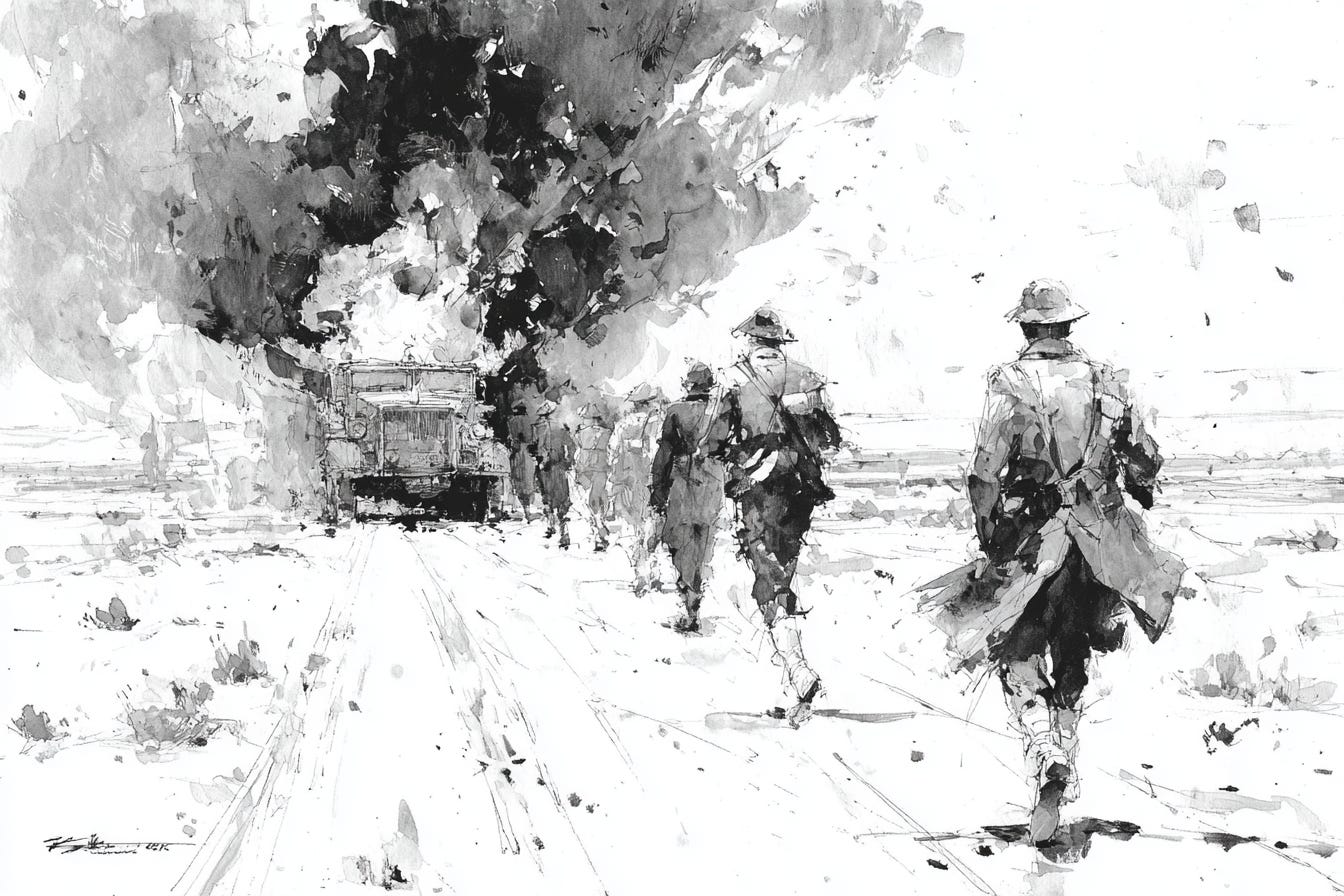
Within five minutes of Reichner’s plea for caution, the detachment came upon the first truck, a wreck of warped and twisted metal, blackened by fire. Papers, boards and excelsior were scattered about, thrown aside as needless weight by the looters.
There were two corpses on the front seat. The chauffeur still had one hand on the emergency brake. Both men were charred beyond human semblance. On the road, near the right rear wheel, a nude body was sprawled, that of the man who had guarded the back.
For half a minute the Legionnaires stood still, afraid to look at each other, afraid to speak. Their years of warfare had hardened them; they had suffered from professional deformation of a peculiar type, affecting the mental rather than the physical. But the fate of the men on the truck might be their lot before long—and to stand in awe too long would be almost an admission of fear.
Burrus bent to scan the tattoo on the dead man’s arm, picked up a brass shell and the white metal slide of a Lebel magazine. His face was very white for the moment, and his lips quivered, but his tone was calm, careless.
“Shot off his blank, the poor devil—then never had time to reload.”
“The tattooing will identify him,” Reichner said in the same casual, flat voice. The head had been cut off and taken asa trophy. “Let’s have a look at the others, now.”
The Legionnaires gathered around the wreckage of the other trucks. Chauffeurs and mechanics were dead, burned to a crisp, like the first men. One of the drivers had fallen forward on his wheel and, as the flames seared away his face, the bones had been bared. Sooty, long teeth grinned jovially. A remnant of shirt sleeve was draped from one wrist, held by a cheap, plated cuff link, which bore the Legion’s badge. An ex-Legionnaire, a man who had once been of their own.
Choukrin, a Russian who had seen more horrors than any man has a right to, fingered the link, an odd look of sympathy and pain sweeping his aristocratic face. Then he saw the others watching him, and flung words from his lips to efface any impression of sentimentality, of weakness.
“Funny world, friend—” he shrugged his thin shoulders and smiled bitterly. “You help me understand many things. Shall we take him down, Sergeant?”
“No stretcher to take him back, and outside my instructions. Asserdoun will send a detachment to care for their dead. Say, the slobs are choosey, aren’t they? Didn’t take the heads from the burned guys. Don’t think any one got away to hide—but orders are orders and I’ll try anyway.” Reichner cupped his hands about his mouth, shouted, “Relief detachment from Post Kitosso—come on out, the road’s safe!”
He repeated the call several times without an answer.
“Better look awhile; some guy may be unconscious somewhere near. A group stays on the road to watch for trouble, ten men come with me.”
The Legionnaires scattered in the bushes. Borgar called soon. Reichner saw that the Legionnaire, a swarthy, cruel chap from the Balkans, former comitadchi, was shaken. Wordlessly the private pointed to a heap of flesh in the lee of a bush. Another body, beheaded, stripped of all garments. But this one had been captured alive—Berbers did not waste time torturing the dead.
One by one the men came to look down at him. Today, tomorrow, they might finish as he had. And they were aghast at the thought of the horrible death, suffered far from their comrades; of the need to remain brave, the conqueror, until consciousness left. They looked away, swore, and took long swigs from their canteens to steady their nerves.
“Snap it up,” Reichner said. “Let’s see, that’s nine stiffs, three to a truck. That’s probably all there were.”
Then, Burrus, looking for bodies, saw the barrels.
To the half hysterical men who were biting their lips to keep from moaning their resentment and grief, the discovery came as an anti-climax, an instant and complete relaxation. Smiles reappeared; they flung themselves into a new interest, a new train of thought, as a man dragged from icy water might warm himself before an open fire. It was better for them to speculate upon the manner in which the barrels had reached their snug rest than to speculate on how many minutes the dead men’s agony had lasted.
“The slobs rolled them off the road to get more room up here,” Choukrin explained, “for the damned fools scorn wine. You’re right, Burrus, they don’t look broken to me. Big fellows, aren’t they?”
“Three hundred liters apiece,” Reichner stated. When it came to casks, barrels, flasks, bottles, he was well informed. “Each of those figures a month’s wine rations for every man at Kitosso. Check it yourself—a pint per man and per day.”
“How will we get them back, that’s the question,” Burrus said.
“Can’t. We’ll tip off the next supply convoy and they’ll be picked up.”
“Like hell!” Burrus protested. “Those transport birds are too lazy to work—they’ll stop off to drink the stuff while it lasts, then check it off to unavoidable leakage and wastage. Shame to let it go like this, Sergeant.”
“What are you going to do about it?” Reichner asked. “They must weigh over six hundred pounds a piece. Feel like carrying one back, Burrus? I’ll hold your rifle.”
“Six hundred liters, Sergeant!” Burrus’ eyes gleamed. “That means thirty quarts each for all of us. Of course, we can’t swallow that much, but we can have a nip.”
“This is a fine spot to stop for a drink.” Reichner became sarcastic. “Suppose the raiders come back and pounce on our necks, what then? You’ll ask them to have a drink, eh?”
“Listen, Sergeant—don’t talk like a line infantryman. Do you think any of us would be worse off for a little wine? We don’t get a chance like this every day, and we’ve been in the sun. Suppose we went down for a few minutes, just to taste it, with you standing by and letting each man get, say, a cup—say two cups? Even a quart wouldn’t bother any man here—”
“If you think I’ll let you get at one end of a barrel of wine, Burrus, you’re crazy. I know you couldn’t be dragged off until you saw the bottom.”
Burrus shrugged, disgruntled. But he knew himself to be the spokesman of the detachment, felt the united hopes hanging to his ability.
“Never thought you’d turn out like that, Sergeant. You like good stuff yourself. And you’re pretty understanding as a rule. What hurts is that this is probably the new wine to replace the stinking, sour, sock juice we’ve been issued. Say we go down, have a drink, then fill up our canteens after throwing out this tobacco syrup they’ve given us lately. What would be the harm?
“Perhaps it’s that special issue we’ve been promised,” Choukrin said, gently. “Two francs fifty wholesale. That’s our luck—lousy stuff is kept, good stuff gets lost.”
Wine is sacred in the French army. The Foreign Legion being, its members will tell you, the élite of the French army, carries the worship of pinard to its highest degree. Often, when finding the body of a comrade, a Legionnaire will weigh the canteen in his hand and say, without humorous intention, “Well, he’d finished his wine, anyway.”
There were traditions to be thought of: It would be the first time in the Corps’ history that twenty thirsty Legionnaires, practically all long service men, and two barrels of good wine had come face to face without result. And Legionnaires led by Wineskin!
Reichner hesitated, was lost. He was a Legionnaire, and no true Legionnaire could have seen, without a tightening of the heart, the tragedy represented by the loss of this quantity of excellent wine. As a small boy he had been taught not to throw his bread crusts away, lest he should repent when hungry. He had a superstitious dread that should he scorn this wine, the time might arrive when he would lack wine.
Wine—which meant more to him than gold to a miser.
“If you’d quit when I said enough,” he weakened.
“Word of honor!” Burrus exclaimed immediately.
“Legionnaire’s word?” Reichner in- sisted.
“Well—” Burrus considered his strength of will, fearing to promise more than he could keep on the one oath he held as sacred. “All right—Legionnaire’s word, Sergeant.”
“Let’s see; we’ll go down four at a time,” Reichner suggested.
“How’d you get the first four back?” Borgar asked.
The Balkanese spoke but seldom, being a stolid man, but his words were always carefully weighed and to the point. Once the top was knocked off a barrel, it would be impossible to bring any man away by mere orders.
“Guess we’ll be safe enough down there,” Reichner opined.
His imagination was at work, and he was growing thirsty rapidly at the thought of free wine.
“We’re in the open up here,” Choukrin put in. “Down below we could hide in the bushes.”
“Let’s go,” Reichner decided quickly.
All scrambled down the declivity at top speed, without another glance at the dead men. The first Legionnaire to reach the barrels thumped his gun’s butt against the staves, which answered with a rich, promising, dull thud: They were full.
Reichner cleaved the crowding men, drove them back with powerful sweeps of his big arms.
“Who’s in charge? Who’s in charge?” he challenged indignantly. “You guys form in line, tin cup ready, get your drink. Then you take the tail of the line again. I’ll stand by and sock the first who tries to sneak up out of his turn right on the nose! This must be done in proper Legion style! Now, to get the top off—”
Neither trenches nor barbed wires ever stopped the Legion. The barrel had no chance. Six bayonets flashed into light, eager hands splintered the wood, tore out the short planks. Then a gasp of disbelief was uttered by every man present. Even Reichner staggered, dazzled by their luck.
“Take it easy,” he protested. “We may be mistaken.”
He dipped his tin cup into the liquid, held it up to the light. No, there could be no mistake; it was transparent gold—white wine instead of ordinary red. He took a sip, rolled it lingeringly around his tongue, splashed it against his palate, sighed and announced—
“First grade.”
“It’s the Greek’s wine,” Burrus declared. He had knelt to decipher the lettering painted on the flank.
The Greek was the lone civilian at Kitosso. He kept the only café. This white wine was undoubtedly the stuff he bottled, sealed with scarlet wax, and sold as sauterne for twelve francs a quart. Reichner felt as if distilled sunshine had caressed his throat and warmed his stomach. The liquid had a faintly sweet, gummy tang that was most pleasing.
“Wait!” The sergeant called for attention, to explain as was his duty. “This isn’t red wine, remember. It’s much stronger. White wine saps your strength, cuts your walking legs right off, makes you sleepy. We want to take it easy—one or two drinks each—that’s all.”
“Sure, sure,” Burrus said impatiently, his cup poised. “Can I start in?”
“Go ahead, Burrus; that’s it—end of the line. Choukrin—Borgar…”
Reichner knew the danger, and had resolved to watch for the first symptom of drunkenness. At the first stagger of the first man, he would stop all drinking, even if he had to spill the barrel on the ground. But habit was strong, and as he checked off each man, he dipped in his own cup, emptied it. The level lowered with startling speed, and he watched it, fascinated, one elbow propped on the edge of the barrel’s rim, looking up from time to time to keep order.
“Burrus—Brooks—Cesari— Sulpice— Hermann—Magers—Burrus— Say, don’t try that again. Each in his turn is what I said. Understood? Choukrin…”
“Fine stuff!”
“Slides down like greased salvation in velvet pants!”
“Don’t need to prime yourself with salted herring!”
The Legionnaires exchanged apprecia-tions. Occasionally a gloomy note would be struck by a careless chap, to remind them of their position.
“Tough on the guys on the trucks. They carted it all this way—and got nothing.”
“One guy’s bad luck makes another guy’s good luck.”
“Those Berber slobs stole macaroni cases and left this!”
“They’re not civilized, anyway.”
“I think that’s enough,” Reichner hinted from time to time. “We better quit—”
“Look at all that’s left, Sergeant—there’s plenty!”
Then Reichner gave up counting the men. They came too swiftly, and their faces seemed all alike. After all, this excellent wine could not harm a Legionnaire. He sat down against the barrel, mechanically passing up his cup to be refilled at frequent intervals. The men dipped their canteens, which came up dripping scintillating pearls. This made things easier, more comfortable; a man could walk aside, sit down in the bushes and drink at leisure.
The comparison of professional soldiers with young boys is ancient, and true. These Legionnaires earned from thirty cents to four dollars a month, out of which princely salary they had to supply themselves with the smaller luxuries of life. The few coppers remaining after purchasing stationery, soap, tooth paste and sewing materials were spent for drink. Before the barrels, they were as helpless, as charmed and as innocent of evil intent as a six year old child visiting a candy shop with his first dollar.
Wine was the embodiment of luxury. The majority had been at Post Kitosso over a year, in the Mid-Atlas fortifications for stretches ranging between thirty-six to forty-eight months. Kasbah-Tadla, with its three hundred-odd European civilians loomed in their minds like a remote, fabulous metropolis. On arrival there, when they came down from hill duty, they had planned to have all the wine they could hold, if they had to spend all their savings. And all the wine they could hold and several hundred liters more were to be obtained here, unexpectedly—and free.
“What time is it?” Choukrin wondered aloud.
“Four o’clock,” Reichner said, after groping for his watch. “We can double part of the way and make the Kitosso by sunset, easy.” He was growing optimistic, and his natural lack of fear was encouraged, multiplied by the increasing elation filling his brain. Six miles—that was no distance at all for Legionnaires.
“We’ll start at five and hop right in. Say, this didn’t turn out such a bad afternoon, did it?”
“Best since the time when I was in Rumania, during the war…”
Choukrin started a long story, studded with alien words, in which flickered scenes of gambling, drinking, dark tresses, brown eyes and pink favors.
“You were an officer, Choukrin?”
“Fate rules—I was. Fate rules…”
“You bet. Now, during the War, I…” Reichner grew reminiscent. There had been a certain Greek wine he had tasted in Salonika, when passing through with the Legion’s March Battalion. “Guess I’m getting old, Choukrin—nearly thirty-five—and things don’t taste the same. Although this stuff…”
One of the youngest men was sick, and loud jeers greeted his unconventional behavior. Burrus lurched nearer, flung one arm on his sergeant’s shoulders.
“Thinks he’s been drinking! Take me, for instance. Last year when I was convalescing from fever—remember how sick I was?—I went to a claque in the reserved quarter at Meknes—yeh, three doors up. Well, a gang of American tourists came in—Brooks was there—he’s English and could talk fine—he told them what I could do and they said he was a liar. Well, I did my stunt. Ate two dozen hard boiled eggs, drank eight quarts of wine, to win a hundred francs. They were paying for the stuff, of course.
“There was a pretty nice girl with them, all pink and white at the start. She kept telling me in rotten French to stop, that I’d get the money anyway; but I have my pride.
“‘Take money, take money; you sick; stop, please; you sick—’ and I’d gulp another egg. She was getting all yellow in the face just watching me down all that stuff. Well, I wasn’t sick; but she sure was! And the old cat who had the place thought she was drunk, mixed her a pick- me-up. That made it worse. What a day that was, eh, Brooks, you youm. Tell ’em about me in Meknes that time.”
But a Legionnaire had fallen halfway into the barrel, striving to retrieve his képi, dropped unguardedly as he reached too swiftly for another cupful. Reichner had to rise to help him out, and became thoughtful.
“Enough. Some of you are getting soused. We go back.”
The canteens were filled with wine, every one had a farewell drink.
“Snap into it,” Reichner urged.
“Let’s roll the other barrel part of the way,” Choukrin suggested. “The lieutenant will send for it in the morning if we get it near enough.”
“Won’t hurt to try,” Reichner agreed.
Six or seven volunteers took hold of the huge cask, pushed up the hill. But the barrel asserted its six hundred pounds, and rolled back constantly—so fast that it was extremely difficult to dodge from its path. Others helped, sweating, grunting.
“Once on the road it’ll be easy,” all declared.
But the barrel was obstinate, kept coming back to the same spot. The men tried chucking it with bayonets after each push. But steel is brittle, and Reichner grew angry after three blades had snapped the glass stems.
“Get out! Leave the damned thing alone. There’ll be busted legs around here. Go on, get out!”
He roamed among the bushes, kicked sleeping men awake. To make sure they were all present, he had them form in combat groups. His somewhat muddled brain could not permit him to count, but his trained eye would have noticed a missing member in a formation at once. The martial array of the detachment could not last on the slope. The soil was rubbery, crumbled under boot soles with treacherous brutality. But they all managed to reach the road after a time.
There was more delay while Choukrin insisted on leaving the dead chauffeurs a few cigarets. He was persistent, oblivious of logic, prey to some vaguely religious atavism which made it right to leave the dead offerings. Other men grouped about the mutilated bodies, cursing the natives, screaming madly at intervals.
“Forward—forward! We haven’t all day!”
Reichner booted and cuffed.
He herded the men forward like sheep, trotting here and there in a swaying lope, much like an elderly dog. He was worried about the broken bayonets, seeking a plausible explanation to save the men punishment. He decided on a confused story—the men had tried to take off a couple of tires still in fair condition…
“Some of you look tight,” he announced. “Breathe deep. Maybe you’ll get by at the gate.”
“Don’t worry. It’ll be dark then,” Choukrin stated.
“Dark?” Reichner looked up at the sky. The sun was low, big clouds dragged orange bellies against the remote violet mountains. The wind had freshened, and the feel of approaching night was in the air. “Sacred millions of horned devils! The lieutenant said to be sure to get back before night.”
“Bah! He’ll be so happy to see us back he’ll kiss us,” Burrus said.
Although he had emptied his tin cup oftener than any one save Reichner, he was calm, walked erect. Only the peculiar, dancing light in his pale pupils revealed anything abnormal.
“Let’s hurry,” Reichner insisted.
“Don’t get them winded at the start,” Burrus advised. “What’s needed is a nice, slow song to start with—getting quicker and quicker songs the nearer we get to the Post. That’s the place where we’ve got to look good and smart, you know.”
Reichner bowed before the obvious logic of this.
“Sing, then.”
“In a minute—let me think.”
Burrus was reputed a fine singer. For ten years his voice had contributed to the excellent spirits of the units he marched with. Old and modern, sentimental and obscene, civilian and military, he had an unlimited stock of songs. Before long, he had made his choice, and he lifted his hoarse.baritone in a whining chant:
“Elle connut pas son père,
Et quand mourut sa mère,
Elle resta seule sur la terre,
Sans gîte et sans pain!
Dès sa plus tendre enfance,
Elle connut la souffrance,
Pour gagner son existence…”1
The Legionnaires oscillated as they marched in rhythm to the chant. Those who recalled the old ballad picked up the chorus and informed the hills:
“There she goes, Maria—terror of the sidewalks! She knocks down the passers-by—and yet all men are crazy about her!”
Burrus was inspired and greeted the fall of night, abrupt as always in North Africa, with the time worn favorite:
“He uttered his call to arms; he fell bathed in his blood. But his death and cries of alarm had saved his regiment!”
Silence returned when they stumbled in the chilly waters of a brook which they knew was within a mile and a half of Kitosso. Where the ford emerged, the trail split into two branches, one leading to the outpost, the other to Kasbah Zagrit.
“I’ve an idea,” Choukrin said, when they reached dry soil.
“Which is?” Reichner prompted.
“To pay a call on Kaid Hammou!”
“That’s not so bright.”
“Your stripes will pop off, anyway.”
“Think so?” Reichner was worried.
“Know so. What’s held you up so far is because you never cut loose on booze while on active duty. They won’t just laugh this off. Nothing to lose—and we’d square things and play a dirty trick on the resident.”
“We’d all be killed.”
“What did we come here for—to live?”
“Seems stupid to me,” Reichner said calmly.
“It does? Think of that guy in the bushes. Think of the others—one had been a Legionnaire. We’re Legionnaires. The Berbers will get away with it; you’ll get reduced; we’ll get the jug; and what does it matter what we do? We’re all soused…”
The idea was appealing. Reichner felt that it would be a stunt well worth the loss of stripes, something that would be talked about for years in the regiments. Of course, it was certain death. Kasbah Zagrit had been attacked before, by a whole mobile group, with mountain artillery, engineer sections, and had not been taken. The hillmen had gathered so thickly from their homes that the slopes seemed to be covered in white cloaks. But the sheer insanity of the undertaking held something sublime, unusual—was a gesture such as Legionnaires will die to make.
Perhaps their sacrifice, their showing the right way to honor the dead, would not go for nothing. The officers would be made to understand how the soldiers felt.
“Come close, you fellows!” he ordered. “Now, Choukrin and I are going to Kasbah Zagrit. We won’t come back. Anybody who wants to can go to the post. Real guys follow us.”
“We’ll stick, Sergeant.”
“Come along, then.”
Here the official report written by the staff officer appears in error. For it is stated very clearly on page four, paragraph five, that the returning detachment lost its way, entered the hostile zone without knowing it.
To be fair, the writer had done much research work, not only delving into French sources, but questioning the native spies paid by France to give information on Kasbah Zagrit and vicinity. These secret agents all agreed on one point: The Legionnaires did not attempt to conceal themselves, as men planning an attack would have done. On the contrary, they came singing and calling out profanely from one man to another.
From their stories, it would seem that the Kaid Hammou was warned of their arrival long before they reached his home. But the watchmen declared they were few in number, most noisy, and the old chieftain believed them a decoy, to draw him from the shelter of the walls.
As it happened, he had only thirty-odd men within call, having ordered all the others to seek shelter in their scattered villages. He had feared—for he evidently did not realize the full stupidity of the resident, or more properly his ardent selfishness—a raid by a squadron of planes, such as he had known before. In this case, a far flung encampment would have attracted the flyers, and many bombs would have come down in reprisal for the attack on the trucks and the killing of the guards.
Therefore, he gave orders to ignore the Legionnaires until morning, when his warriors would return from their hiding places and massacre them easily. That explains the officer’s statement that the detachment was lost. From then on, the two versions agree as to actual events, but differ widely in details, such as what motivated each episode, what was said, what was expected.
It was after eleven o’clock that the Legion detachment sighted Kasbah Zagrit. There had been two halts, during which the heavy canteens had been considerably lightened. This had contributed to stiffen certain vacillating resolutions.
Reichner led his men into the vast open area before the fortress and stared at the formidable outline flung darkly against the sky. In the milky moonlight, the red bricks turned to an intense black, and with its jutting, square towers, its massive redans, Kasbah Zagrit evoked in the sergeant’s mind long forgotten engravings seen in story books, showing the gloomy castles of Teutonic fairy tales.
“Stay back. I’m going to speak my piece.”
He strode toward the high walls, located the gate and struck the wood with the iron shod butt of his carbine. The blows echoed less dismally in the empty courtyard beyond than within his own chest.
“Who are you?” some one asked in Arabic.
This showed Reichner that his identity was known. Else the question, addressed to a man of the hills, would have been spoken in Chleuh.
“Detachment of Legion from the French Post.”
“What dost thou seek?”
“The Kaid Hammou!”
“Why?”
“Why?” Reichner thought quickly. “To make him a prisoner for the murdering of nine French soldiers.”
The sergeant chuckled, satisfied. The immense insolence of his words thrilled him. To come before these walls, on which a column sixteen hundred strong had broken its teeth in the past, and ask for the Kaid Hammou was a trick such as few men, even Legionnaires, might boast of.
“Go thy way. Allah will open another door.”
Reichner stepped back, related his conversation to Choukrin.
“Guess that surprised him.”
“I’ll bet!” Reichner raised his voice, “Get ready, lads! When they open the gate to rush us, fire away. Kill as many as you can. Sorry I brought you here—but the wine being drawn it must be drunk.”
The proverb seemed oddly fitting. They formed a small, resolute square, bristling with rifles. All of them believed that there were hundreds of men nearby, that they were living their last hour. But long minutes passed and nothing happened. Reichner was finding out that it takes almost as much effort to be massacred when you desire to be, as to avoid massacre at other times.
“We can’t stay like this all night,” Burrus said.
“Hate to start back,” Reichner spoke, “after talking the way I did. We’ll look like damned fools to those guys.”
“The minute you turned your heels,” Choukrin stated, “they’d be out, cutting across country to ambush us elsewhere. Only one thing to do.”
“What?”
“Attack,” Choukrin suggested gently.
“Then what?”
“Bayonet as many as we can until we drop.”
“How? We can’t break that gate.”
“No?” Choukrin rested one hand on Reichner’s arm. “What job was scheduled for my squad for today, if this detachment had not been sent out on special duty?”
“Quarrying.”
“Who handles the explosives? I do. Feel anything in my musette bag? Yes, four of them. The two of us go forward, you keep them busy talking, and I do my job. After the explosion, every one goes in with the pitch fork.”
“How many men are in there?”
“Fine time to think of that. We’ll have plenty of time to get clear after I plant my sticks. Special slow fuses—we were working under a ledge at the quarry. Come on!”
Reichner pounded on the gate once more. He shouted, screamed insults—but no one answered. Choukrin was placing his sticks. A match sputtered, went out. Again came that sinister crackling, the smell of sulphur; a tiny yellow flame bloomed.
“Back!”
As they ran, a nervous guard atop the wall discharged his Mauser toward them. The bullet smacked ahead of Reichner. This was the signal for a general volley, and the sergeant heard the keen, eager drone of the missiles, heard the significant impact of lead into flesh.
A man went down.
Before Reichner could ascertain who had fallen, the charges exploded, and he involuntarily sheltered his face within his arms. Then he gave the order to go forward and all plunged ahead, with débris raining down everywhere, while a nerve twisting screaming stabbed the night—the wails of frightened women.
Neither the staff officer nor Reichner were able to reconstruct the events of the following thirty minutes. Grenades were used at first, on the nearest groups of defenders. But the men had not carried many. Most of the work was done with butts and bayonets, pistols and knives. The Legionnaires fought superbly—the better perhaps because not a few of them saw double and acted with consequent despair.
The sergeant did not try to keep his men together; the labyrinth of corridors inside the Kasbah forbade this. The Legionnaires roamed at will, entered doors at random, climbed stairs, leaped down from balconies into open yards, stabbing, clubbing. Before these men who laughed and cursed, who staggered about yet sent their lunges and shots home with precision, the defenders melted.
Reichner vaguely recalled passing under arched gates, stumbling up stairs. But his first really clear moment after the explosion was when he found himself on a spacious veranda, hugging one of the supporting square pillars. Below was a moonlit garden.
Choukrin stood near, firing his rifle across the open space, into a huddle of white figures on the opposite veranda. Reichner’s carbine was empty, the heavy calibered Ruby automatic was in his hand.
He was shooting down nearer opponents, ten or fifteen yards away.
And even while he pressed the trigger he was aware that in the garden below him figures flitted and darted in aimless confusion, in a sort of whitish pit streaked with short spurts of flame from which arose roars of rage, stentorian, ribald laughter, oaths, screams of pain and the shrill, piercing notes of sheer terror.
Then Choukrin stood calmly, refilling his magazine.
“They’ve run,” he announced.
“Here’s one alive,” Reichner grunted, lifting his pistol.
A man was crawling on all fours toward the entrance to a stairway. Choukrin knocked the sergeant’s hand aside, the bullet was lost.
Then the Russian leaped on the native. “Tell him to take us to Hammou’s room!”
Reichner understood Choukrin’s wish, and spoke as directed. With the hard muzzle of the pistol in the small of his back, the fellow did not argue; he led the way.
As they walked, Legionnaires emerged from passageways, recognized their chief and fell in behind. Then the guide indicated a door, fell on his knees, hiding his face against the wall.
The panel splintered under the gun butts, iron bars rattled to the floor. The room was not very large; thick rugs covered the tiled floor. There was no furniture save leather cushions and a wide divan. Light was supplied by a great kerosene lamp concealed in an immense glass chandelier hanging by gilt chains from the ceiling.
Two men rose to face the Légionnaires—one young, beardless, evidently terrorized, the other a tall, white bearded native with intense, fierce black eyes. For a moment there was silence, and no one moved. Reichner was aware of shots and shouts from other parts of the building.
“Créve toujours le giron,” said some one.
A rifle was leveled, a detonation filled the room. The young man stared, slithered sideways, remained motionless on the couch.
The old chap leaped forward, but Reichner knocked the knife from his hand, gripped his shoulders with one powerful paw. He had no intention of killing him—did not want him to be killed. This man was Hammou, worth more alive than dead.
“Prisoner,” the sergeant said. “In the name—of the law!”
For Reichner remembered that he was not taking part in a battle, but arresting an assassin on his private initiative.
But Choukrin grasped the man’s arm roughly, brought the wrist before Reichner’s eyes. There was a cheap little watch of imitation silver, fastened by a worn strap. Clamped in the leather was the metal badge of the transport corps.
“Prisoner—hell!”
And another Legionnaire pushed forward, shouting incoherently. He held two round objects at arm’s length, close to Reichner’s face: Two heads—the heads of Frenchmen, freshly cut.
“Hanging under the vault—hanging under the vault! I found them!”
“All right,”’ Reichner agreed.
Choukrin grasped the white beard with one hand, clawed with the outstretched fingers of the other. Men leaped forward, struck out with clenched fists, swearing, howling, sobbing. They were not so much avenging those already dead as paying for their own mutilation in advance. The shaven skull bobbed and bobbed, vanished in the middle of the soldiers.
“He tortured that guy—”
“Here’s one the resident won’t save—”
“Let me at him—let me at him!”
Reichner sobered instantly. His duty as a leader came back with his finer instincts as a man. There were six, eight, young, strong men against one old fellow. This was not right, no matter the crime.
“Quit that, quit that! Are you Legionnaires or not?”
“Ask that of the poor devils on the trucks,” Choukrin snarled.
But he was the first to release his hold, and seemed ashamed. The others imitated him. The kaid rolled to the floor like a doll emptied of its sawdust.
He was dead.
Reichner left the room, ran back to the gate. He blew the rallying signal on his whistle, and men came toward the spot from every side. He counted them.
“Twelve—not so bad!”
“It was Brooks who got his outside; Sulpice went down in the garden; two of them cleaned up Borgar on the stairs after he had dropped five—prettiest thing you ever saw…”
The missing were accounted for one by one. The survivors were all wounded, not severely: Slashes, rips and punctures meriting nothing more than iodine and first aid bandages.
“Dig up timbers and mend that gate—the others will be coming soon,” Reichner ordered. “And make sure there’s nobody left in here.”
“Nothing but women and kids,” Burrus said. “Told them to keep quiet and nothing would happen to them.”
Reichner nodded, with dignity.
“Nothing is right! Even a good souse ends.”
The affair was not settled without considerable trouble. Picard had reported the lost of the detachment to Asserdoun, and two companies were sent out to help locate it. They were very useful in freeing Reichner and his men from the circle of natives which had closed around the Kasbah within a few hours.
But when the smoke cleared, all had to admit the evidence: Reichner and his twenty Legionnaires had achieved something that had defied a mobile group. Luck had been with them, of course, but luck goes to him who makes it.
The resident was doubtless shocked by the slaughter. But he soon saw that he could never admit that such a stunt, which compelled the admiration from all the troops in Morocco, had been accomplished against his orders.
He posted up a very fine proclamation, in which he mentioned the iron fist in the velvet glove. He pointed out that the prompt punishment of the assassins was the best refutation to his enemies who said he lacked strength.
The valiant Legionnaires who had participated in the exploit would one and all receive the War Cross. Even those dead would be posthumously honored. To Choukrin and Burrus, who had distinguished themselves particularly, was awarded the Military Medal. As for the heroic sergeant commanding, he already had all the decorations within the gift of the French Republic—save the Cross of the Legion of Honor.
The resident was no miser, and granted him the Cross!
Picard was angry and was sulky with Reichner for a time, until the sergeant confessed the truth.
“You should be court-martialed instead of decorated,” he declared, “although turning a collective souse into a feat like yours is perhaps worthy of the Cross.”
Reichner brooded, grew ashamed of himself as the days passed. Soon, he would have to stand before the assembled regiment to be knighted. And he was tortured by the thought that he was not really deserving. His conscience protested at his being rewarded for disobedience.
What decided him to clear up matters was the staff officer’s report, which was published full length in the African Army’s Magazine. Reichner was appalled when he read it. It was so inflated, exaggerated everything. For instance, he could not remember feeling “heroic indignation” or “the irresistible urge to avenge French honor.” His part in the fighting had been no more important than that of any other Legionnaire, certainly had been nothing worth “recalling one of Homer’s chants.”
His duty was clear; the truth must be told.
The others deserved what they had been given, for they had obeyed him, their superior. He would be careful not to take credit from them. After all, as his drunkenness had started the affair, the only drunkenness he needed to mention was his own.
He fortified himself with a bottle of Cinzano, locked the door of his room, labored an entire evening, tearing pages, correcting statements, seeking elusive words. The report started as follows:
“The Post of Asserdoun telegraphed Post Kitosso, gravely fearing that the smokes which Lieutenant Picard, commanding, had seen were out of the normal, perhaps indicative of the chauffeurs’ combustion. As a fatigue party was about to start for the quarry, other Legionnaires were added to vary its purpose and form a detachment of which I, Sergeant Reichner, took command without thinking of the explosives. Lieutenant Picard made it very plain that if I failed to return by daylight I would have to march in the dark…”
According to regulations which make it compulsory for reports to be forwarded by a man’s direct superior, he submitted the document to Picard the following morning.
“Sure you want this sent in, Reichner?”
“Can’t let those lies go on about me, Lieutenant.”
“It does credit to your honesty,” Picard admitted, “but that’s about all.”
The report came back from Meknes within a fortnight, which is record time for a report. Reichner was sent for.
“Colonel said to destroy it,” Picard began.
“Why?”
“Conflicts with the official version.”
“But I was there—I saw—”
“Surely—” Picard nodded, very kindly. “It was a nice report, a damned good report; probably the best I’ve ever seen of yours. Lots of interesting points in it. The newspapers would have liked to learn the effect of imitation Sauterne on modern infantry formations. I’m sorry, Reichner, but I have bad news for you.”
“Go ahead, Lieutenant.”
Reichner smiled the smile of a martyr. When the work he had perspired over a whole evening was scorned and ordered destroyed, he did not much care what else happened.
“The colonel instructs me to tell you privately that you have your recent citation to thank for not being reduced to the ranks. As it is, he was lenient, he claims. Reichner, it is my painful duty to inform you that you are confined to your quarters, with loss of privileges, for eight days.”
“Eight days, Lieutenant?”
“Eight days, Reichner.”
“Why?”
“That report.”
Reichner understood less and less. Then he remembered other punishments received while at Meknes, where they bothered over trifles, and recalled the familiar wording.
“For drinking when making a report, Lieutenant?”
Picard consulted the paper spread before him.
“For writing a report when drunk,” he corrected.
Reichner never was quite sure of the difference.
She never knew her father
And when her mother died,
She remained alone on earth,
With neither home or bread!
From her earliest childhood,
She knew naught but suffering,
And to earn her living…
"...greased salvation in velvet pants"...??